A research team led by Ziguang Zhao at the Hangzhou Institute of Medicine of the Chinese Academy of Sciences has developed a gel-based ion transporter system that mimics aspects of signal processing in biological synapses. The study was published in Nature Electronics on September 10, 2026.
Biological nerves use ions to transmit signals. Many artificial devices designed to mimic neural functions control ion movement by confining ions within nanoscale spaces. However, interactions at these small interfaces have a limited range, and interference between ionic signals can arise when the devices are integrated. These constraints make it difficult to build larger and more versatile systems.
To address these limitations, the researchers drew inspiration from the series of interfaces that regulate signal transmission at biological synapses. They designed the ion transporter system using a multiphasic gel, in which distinct regions form a series of interfaces that control ion movement.
These interfaces slow ion movement and allow ions to accumulate in localized traps. As the applied voltage changes, the traps build up or dissipate, changing how readily ions pass through the system. Its response therefore depends on previous stimulation.
In laboratory tests, the system switched between high and low ionic conductance in both directions, a behaviour known as bipolar ionic rectification. Rectification ratios exceeded 1,000 at millivolt-scale voltages. The reported energy consumption for neuromorphic processing was as low as 0.61 picojoules per spike.
By adjusting the strength and timing of input pulses, the researchers reproduced changes in signal transmission analogous to the strengthening and weakening of synaptic connections. The system also showed short- and long-term memory effects. Different channel compositions reproduced Hebbian and anti-Hebbian learning, while combining two channels reproduced the Bienenstock–Cooper–Munro learning rule. These rules describe how synaptic connections change with neural activity.
To test how the ion transporter system could interact with biological nerves, the researchers built a neuro-iontronic processor by integrating two channels based on the ion transporter system. They connected the processor to the two ends of a transected sciatic nerve in rats.
The processor was driven directly by electrical signals from the nerve itself, without an external power supply or additional electrical input. It restored signal transmission across the interruption and could strengthen or weaken downstream neural signals. Recordings of muscle electrical activity showed corresponding changes in muscle activation.
The findings suggest that the ion transporter system could provide a basis for neural interfaces that use ions to process biological signals.
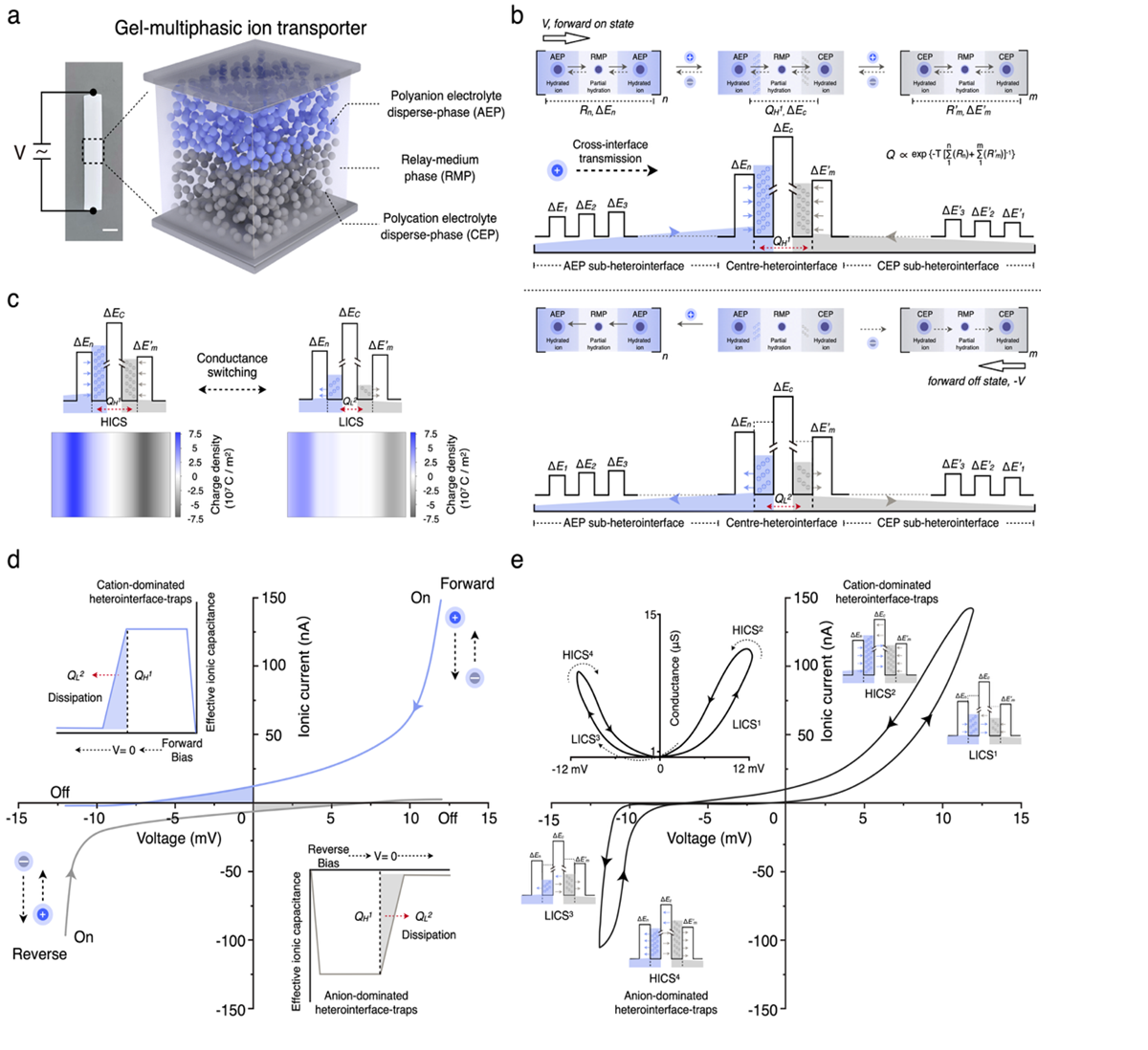
Figure 1. Structure and ion transport mechanism of the gel-based ion transporter system.
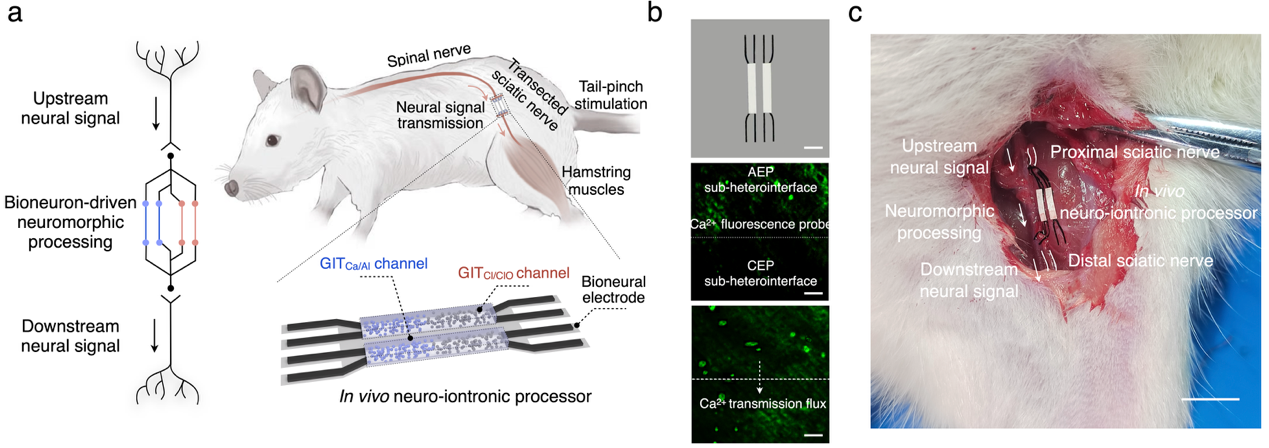
Figure 2. A neuro-iontronic processor incorporating two channels based on the ion transporter system and connected to a transected rat sciatic nerve.